WR001: Crying and laughing but mostly crying
It's not all bad, is it?

The start of the Worth Reading series. What a time. We're kicking things off with a piece called Life is Going to Be Great Really Soon and Here's the Proof!
Just joking.
The altar of Workism and its flamed disciples
Why is everyone in tech so sad? | Aaron Horwath | Noema Magazine | Link
If Elon Musk and co are to be believed, we're entering the Age of Abundance. You and I, we can't conceive how good it's going to be – we've never experienced anything like it!
The Age of Abundance is painted in bright colours and highly saturated strokes and is designed to alleviate anxiety over the future, warming you from the inside out. Maybe it's all accurate, maybe the light will shine on us and we'll be able to bask in the loving rays of Big Tech's ingenuity and inexorable progress. It's a nice thought.
Right now there is, however, something we can vividly conceive: the journey to get there isn't going to be pleasant.
In his essay Why is everyone in tech so sad? Aaron Horwath explores the new challenges knowledge workers face in attempting to keep turning up to their cubicles and Microsoft Teams meetings.
Horwath sees the creation of advanced AI and its continual widespread implementation in the workplace as leaving knowledge workers in a kind of existential angst. He paints the worker's plight like this:
...waking up one morning at an existential precipice, struck with a sudden sense that knowledge work is, and perhaps always has been, pointless. Perhaps you too have felt such a feeling, a rising tide of overwhelming, indescribable melancholy, slowly threatening to envelop you in your Ikea office chair.
Horwath then proceeds to unpack how the worker has found themselves in this predicament and whether what they're facing is a betrayal of the tacit agreement of Workism:
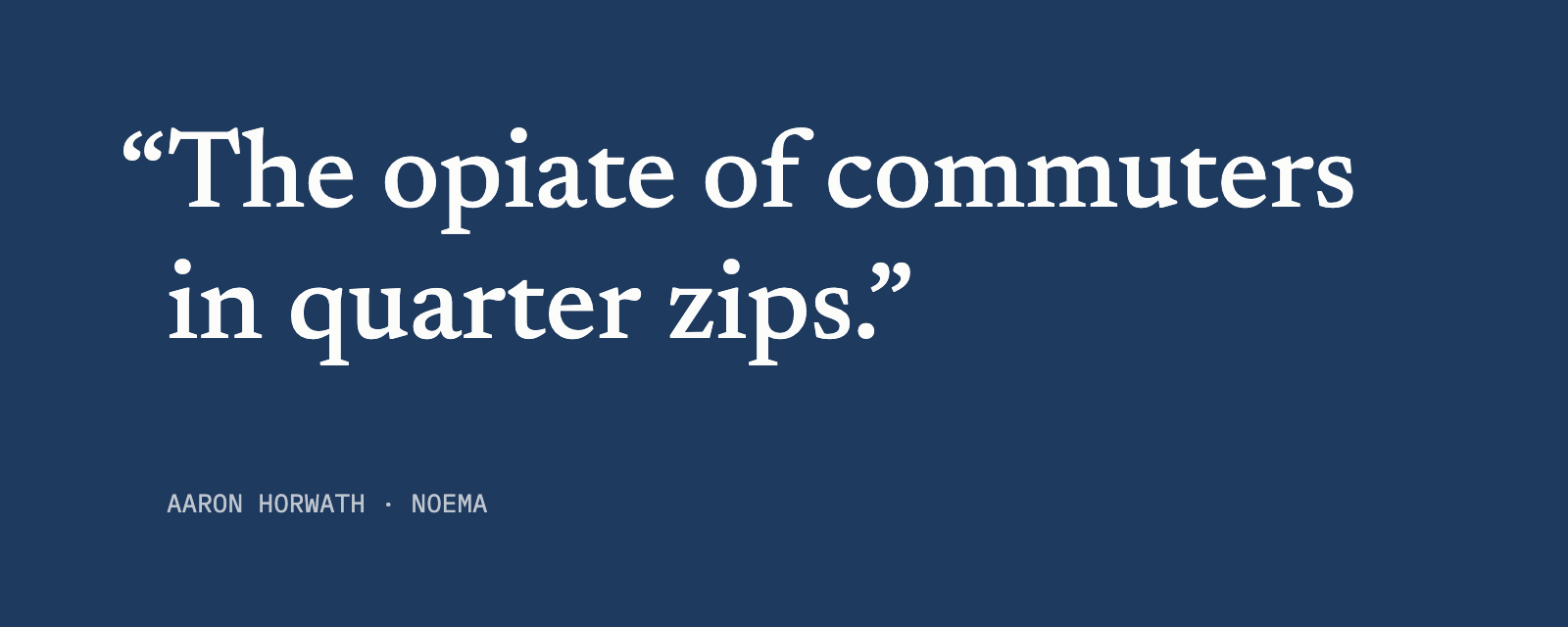
That’s the true beauty of Workism: It is manufactured to distract people from the hole in their souls that a vocation would otherwise fill. It is the opiate of commuters in quarter zips. And it works. It keeps talented people showing up at the office to argue over reports and strategy documents and rebrandings with the seriousness of pediatric heart surgery.
There are some banging lines in this piece and opiate of commuters in quarter zips is one of them.
Horwath introduces the idea of the spectacle, a concept he takes from the French theorist Guy Debord and his 1967 book The Society of the Spectacle. For Debord, modern life is something we watch rather than live. Spectacle is life at one step removed.
AI in the workplace has the ability to distance us further from our work. To create an even greater sense of spectacle, and to, above all else, make it increasingly hard to give a shit. There's also a desire to remove oneself from the scene, a very human response to feeling uncomfortable or uneasy. Horwath is seeing this play out already:
Among my Knowledge Worker peers, I am hearing this more and more often: people who want to pick up pottery, painting, crochet or other old-timey analog hobbies. In coffee shops and in the low-lit corners of bars, professionals are sharing dreams of “disappearing” or “living on a farm somewhere” or “going off the grid.”
I resonate with the compulsion to step away from screens in my spare time. It is a good way of demarcating the work and the personal, although hard to implement in practice. I bought a printer to take my online reading offline. While this is a small act of disengagement, it might be my best purchase this year.
An interesting point Horwath makes is that the willingness to throw oneself into an analogue hobby, as he describes it, can soon become a new form of potential entrapment, with the hobby having to justify or sustain itself through commercial returns.
At some point, in other words, the spectacle will put economic pressure on you that you’ll need to meet. In today’s world, that might mean starting a YouTube channel and a Substack about how you abandoned your tech career to start a horse rescue farm, ultimately turning yourself and your life into a commodity that feeds the larger societal spectacle. Or it might mean starting a company of your own, thereby suddenly needing to create a spectacle attractive to potential employees. Either way, you are doomed to exit one version of the spectacle only to be absorbed into another one. That’s the logic of the spectacle: It reabsorbs even the dissatisfied in order to sustain itself.
It all sounds rather depressing, but I found it fascinating and enjoyed Horwath's humanist tone. He leaves us with this advice on combatting our current plight:
But perhaps the most powerful action of all is simply to maintain an awareness (and remind others) that Workism is a spectacle. For most employees, we owe it to each other to remind one another that this work is not, in the grand scheme of things, all that important. It is illusory. No one has ever died over a spreadsheet. The world does not wait with bated breath for product launches. A marketing campaign will not change the world. Almost no one will remember all the work we do. But they might remember the types of people we were, the relationships we had and how we treated the people we worked with.
Displays of passion are the quickest way to my emotional centre
When A.I. comes for your purpose in life | The Daily | The New York Times | Link
Worth Reading is not a series designed to showcase podcasts, but this episode of The New York Times' The Daily had a visceral effect on me and demanded to be included.
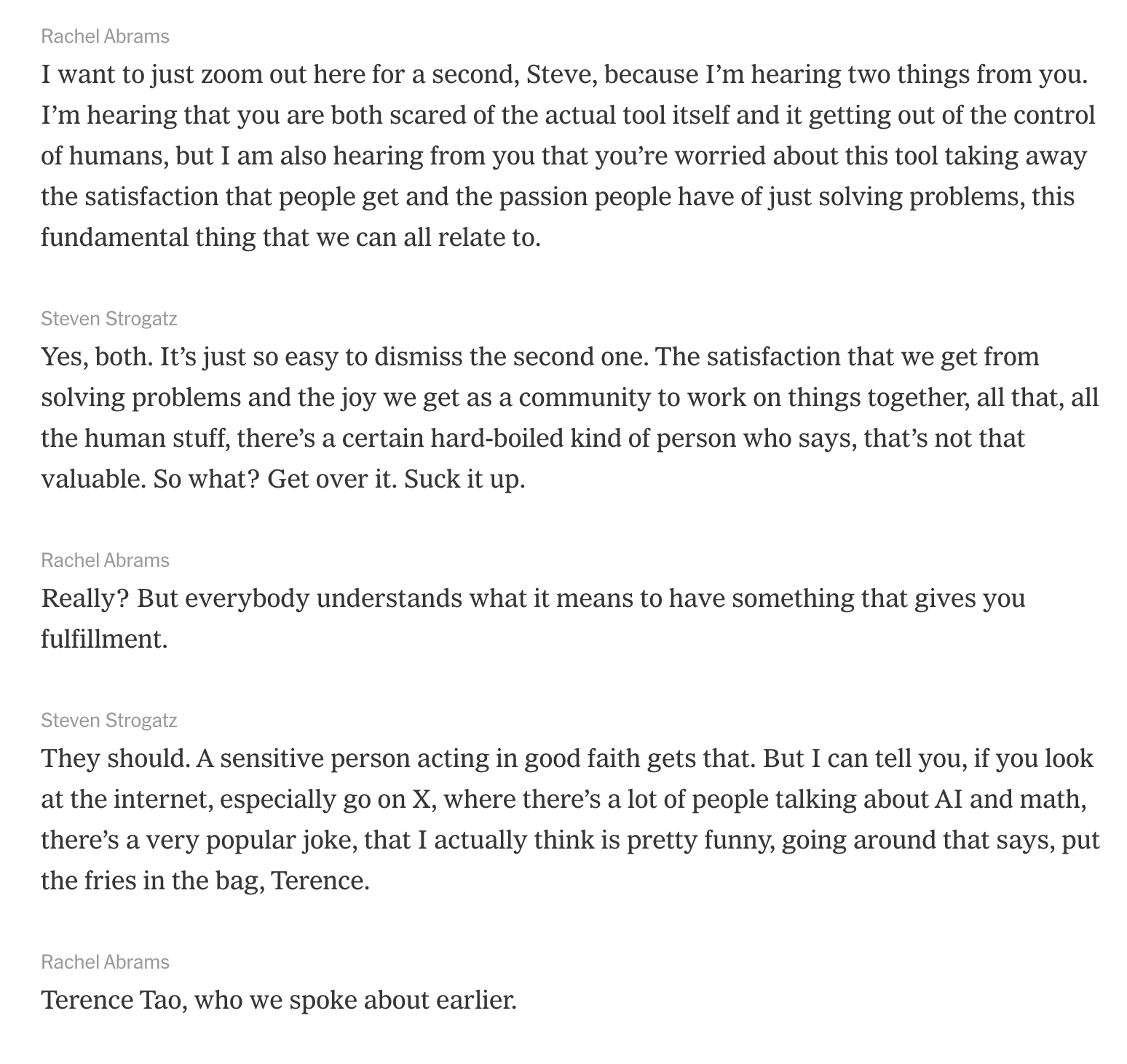
A mathematician I'd never heard of – no surprises there – called Steven Strogatz is given the tough task of summarising the collective feeling of the mathematics community as artificial intelligence solves some of its longest-standing problems (or riddles as he characterises them).
Strogatz, a Cornell University professor, has a raspy voice which breaks as he's running downhill on an idea he's passionate about. And he lives in my head rent free.
Strogatz's emotional equilibrium oscillates between moments of laughter and moments of tears. And if that sounds a bit extreme or untrue, it isn't, and if that sounds a bit too much humanity for one podcast, it isn't. To me, he became almost a kind of hero, conveying a sense of gravitas about a subject I have no attachment or care for; he made me care deeply. He brought the human side of the situation across perfectly.
Leaving us with a tacit question to answer: what is it all for?
For more on AI and mathematics, read Rivka Galchen's New Yorker profile of Terence Tao.
Get off our lawn
Websites are closing their doors to AI agents | Emma Roth | The Verge | Link
The capitalist patrons of the internet are tossing and turning at night. They've spent years creating parameters to keep bots out.
Bots = bad, harmful actors. Bots = spam.
But now, in the nascent light of this agentic future, they're conflicted – could they make more money letting bots in? God, you've got to feel for them, it's a regular old Sophie's Choice.
Platforms like Shopify are on the tarmac with the orange sticks waving our ethereal friends in, but not everyone shares their eagerness. Emma Roth's piece highlights the sites that are saying no (for now). Most only want humans (until humans no longer shop with anything aside from bots).
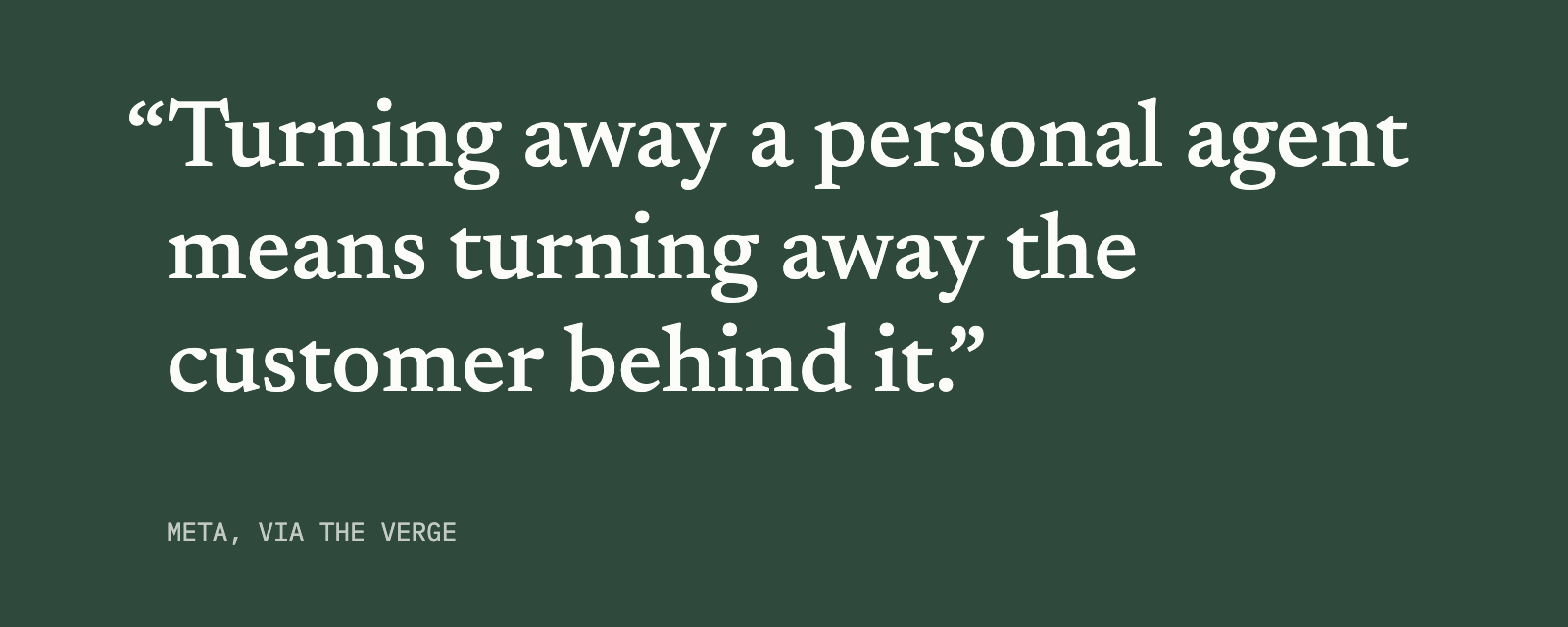
Muse, Meta's personal AI agent launched in September, escalated the decision making among digital marketplace giants, but the response is mixed. Walmart, Gap, Sephora? Yes. Amazon? Get the hell off my lawn.
Worth Reading is a series of notes on the essays, reporting and papers that have left a mark on how I think about decision engines.